
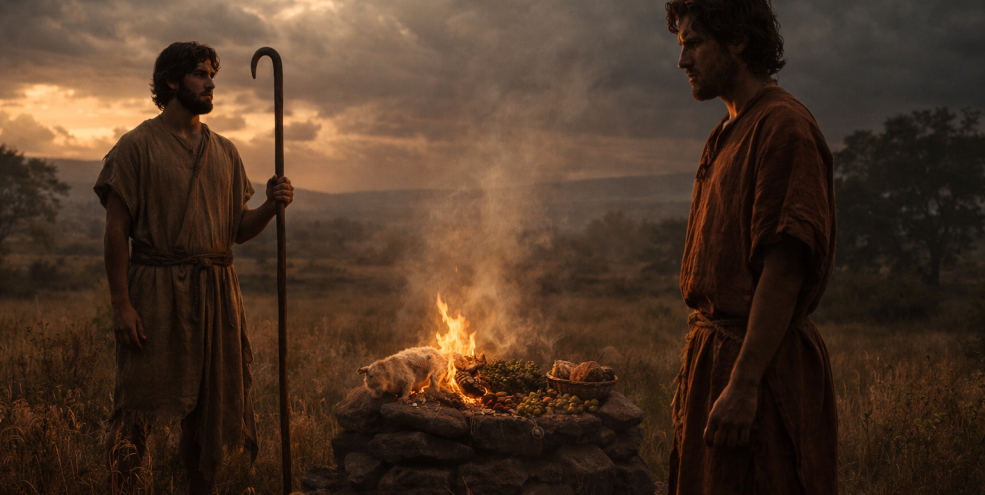
The story now shifts after the peace of Eden is broken. Life outside the garden has begun, and with it comes struggle, hardship, and a new reality shaped by sin. What happens next in the Book of Genesis is both powerful and sobering. It is the story of the first family—and the first murder.
The First Children Are Born
Adam and Eve begin their life outside the Garden of Eden. Soon, they have children.
Their first son is named Cain. Eve recognizes God’s hand in his birth, saying she has gotten a man from the Lord. Later, she gives birth to another son named Abel.
The two brothers grow up with different roles.
Cain becomes a farmer, working the ground.
Abel becomes a shepherd, caring for flocks.
Both lives are meaningful. Both are part of providing and sustaining life. But their paths will soon lead them in very different directions.
Two Offerings, Two Hearts
At some point, both Cain and Abel bring offerings to God.
Cain brings fruit from the ground—what he has grown.
Abel brings the firstborn of his flock—the best he has.
On the surface, both offerings seem acceptable. But something deeper is happening.
God respects Abel and his offering.
But He does not respect Cain and his offering.
This moment is not just about what was given—it is about how it was given.
Abel brings his best, with faith and honor.
Cain brings an offering, but without the same heart.
This is the first lesson: God sees beyond actions—He sees the heart behind them.
Anger Begins to Grow
Cain becomes very angry.
The Bible tells us his countenance falls—his expression changes. His disappointment turns into something deeper. Instead of reflecting on what went wrong, he allows anger to take hold.
God speaks to Cain directly.
He asks why he is angry and warns him with a powerful truth:
“Sin lieth at the door. And unto thee shall be his desire, and thou shalt rule over him.” (Genesis chapter 4 verse 7)
This is one of the clearest warnings in Scripture.
Sin is pictured as something waiting—like a predator at the door. It is ready to take control. But Cain is told he has a choice. He can rule over it.
This moment is critical.
Cain is not forced into what comes next. He is warned. He is given a chance to choose differently.
The First Murder
Instead of listening, Cain acts on his anger.
He invites Abel into the field.
And there, away from others, Cain rises up against his brother and kills him.
This is the first murder in human history.
It is a shocking moment. Just one generation after creation, sin has escalated from disobedience to violence.
Jealousy has turned into hatred.
Anger has turned into action.
The consequences of sin are now fully visible.
God Confronts Cain
After the act, God comes to Cain.
He asks a simple question:
“Where is Abel thy brother?” (Genesis chapter 4 verse 9)
Cain responds with defiance:
“I know not: Am I my brother’s keeper?”
This response reveals something important. Cain not only committed the act—he now refuses responsibility.
But God already knows.
He says:
“The voice of thy brother’s blood crieth unto me from the ground.”
This powerful statement shows that nothing is hidden from God. Even what is done in secret is seen.
The Consequence
God declares Cain’s punishment.
The ground, which Cain worked, will no longer yield its strength to him. His work will become harder and less fruitful.
Cain will become a fugitive and a wanderer on the earth.
This is not just a physical consequence—it is a life of separation, instability, and restlessness.
Cain immediately realizes the weight of this judgment.
He says his punishment is greater than he can bear. He fears that others will kill him.
Mercy in the Midst of Judgment
Even in this moment, God shows mercy.
He places a mark on Cain—not as a curse, but as protection.
God declares that anyone who kills Cain will face greater judgment.
This reveals an important truth:
Even when justice is given, mercy is still present.
God does not ignore sin—but He also does not abandon completely.
Cain Leaves the Presence of the Lord
The story ends with a quiet but powerful statement:
Cain goes out from the presence of the Lord.
This is the deepest consequence of all.
More than the wandering…
More than the struggle…
More than the fear…
It is separation from God.
What This Means for You
This story is not just about two brothers. It is about the condition of the human heart.
First, it shows that sin begins internally. Cain’s problem started long before the act. It began with jealousy and anger that were left unchecked.
Second, it reveals that we always have a choice. God warned Cain before he acted. The same is true today—there are moments when we know what is right, and we must choose.
Third, it reminds us that actions have consequences. What we do matters—not just to us, but to others.
Fourth, it shows that God sees everything. Nothing is hidden. Every action, every thought, every motive is known.
And finally, it reveals both justice and mercy. God judges sin, but He also shows compassion—even to Cain.
A Warning That Still Speaks Today
The warning given to Cain still applies:
Sin is always close.
It is always waiting.
But it does not have to control you.
You can choose differently.
Final Notes
The story of Cain and Abel is one of the most sobering moments in the Bible. It shows how quickly things can go wrong when the heart is not right.
But it also teaches something deeper.
God speaks before destruction comes.
God warns before judgment falls.
The question is whether we listen.
Because from the very beginning, the battle has never just been about actions.
It has always been about the heart.
Add comment