
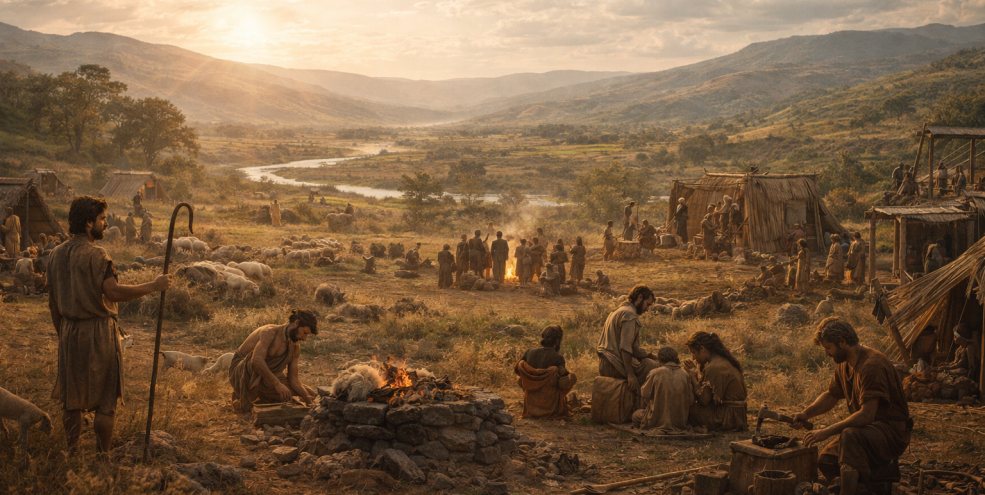
After the story of Cain and Abel, the focus of the Book of Genesis shifts from one tragic event to something much broader—the growth of humanity across the earth.
This part of Genesis may seem quieter at first, but it carries powerful meaning. It shows how life continued, how families grew, and how two very different paths began to form among people.
Cain Builds a Life Away from God
After leaving the presence of the Lord, Cain begins a new life.
He settles in a land called Nod, east of Eden. There, he builds a city and names it after his son, Enoch.
This is the first mention of a city in the Bible.
Even after judgment, life continues. People organize, build, and create structure. Civilization begins to take shape.
Cain’s descendants continue to grow, and with them come advancements.
The Rise of Culture and Skill
As Cain’s family line expands, new developments appear.
We are introduced to individuals who represent important milestones:
- Jabal becomes the father of those who dwell in tents and raise livestock
- Jubal becomes the father of those who play musical instruments
- Tubal-cain becomes a worker in brass and iron
These details show the beginnings of culture, art, and technology.
Humanity is not standing still. It is advancing.
Music is created.
Tools are developed.
Communities are formed.
Even in a fallen world, creativity and progress continue.
Sin Continues to Grow
But alongside progress, something else grows—sin.
One man, Lamech, stands out in Cain’s lineage.
He boasts about killing a man and speaks with pride about it. His words show how far the human heart has drifted.
Violence is no longer shocking—it is becoming accepted.
This is a key turning point.
What began with Cain’s anger has now spread into a pattern of behavior. Sin is no longer isolated—it is multiplying.
A New Beginning Through Seth
The story then shifts back to Adam and Eve.
They have another son, and they name him Seth.
Eve recognizes that God has appointed Seth as a replacement for Abel.
Through Seth, a new line begins.
And something important happens in this line:
“Then began men to call upon the name of the Lord.” (Genesis chapter 4 verse 26)
This marks a spiritual shift.
While Cain’s descendants move further away from God, Seth’s descendants begin to seek Him.
Now we see two paths clearly forming:
- One focused on human advancement without God
- One focused on relationship with God
The Generations of Adam
Genesis chapter 5 provides a detailed genealogy—from Adam through Seth and onward.
At first glance, it may seem like just a list of names. But it tells an important story.
It shows continuity.
Life continues from one generation to the next. Families grow. Time moves forward.
Each person is named, their lifespan is recorded, and then a repeated phrase appears:
“And he died.”
This phrase is repeated again and again.
It reminds us of something introduced earlier—the consequence of sin.
Death has entered the world.
No matter how long people live, the outcome is the same.
Long Lives, Lasting Impact
One of the most striking details in this chapter is how long people lived.
Many lived hundreds of years—far longer than we see today.
This allowed generations to overlap significantly.
Knowledge, stories, and experiences could be passed down directly across many lifetimes.
It was a world still close to its beginning.
Enoch Walks with God
In the middle of this genealogy, one name stands out—Enoch.
Instead of the usual pattern, something different is said about him:
He walked with God.
And then, instead of saying “he died,” the Bible says:
“He was not; for God took him.” (Genesis chapter 5 verse 24)
This is unique.
Enoch’s life shows that even in a world where death is the norm, a close relationship with God stands apart.
He becomes a picture of faithfulness in a growing world of sin.
The Birth of Noah
The chapter concludes with the birth of Noah.
His father, Lamech (not the same as Cain’s descendant), gives him a name with meaning.
Noah means rest or comfort.
Lamech expresses hope that Noah will bring relief from the hardship of working the ground—a direct result of the curse after the fall.
This introduces anticipation.
Something is coming.
A new chapter is about to begin.
Two Paths in One World
As humanity spreads, two distinct paths become clear.
On one side, there is growth in skill, culture, and society—but also increasing distance from God.
On the other side, there is a line of people who seek God, call on His name, and walk with Him.
This contrast is important.
It shows that even as the world changes, individuals still choose their direction.
What This Means for You
This part of Genesis may not have dramatic events like the flood or the fall, but it speaks in a different way.
It shows that everyday life matters.
Generations matter.
Choices matter.
Direction matters.
First, it reminds us that life continues, even after failure. Adam and Eve experienced loss, yet their story did not end.
Second, it shows that progress does not equal righteousness. People can build cities, create music, and develop technology, yet still move away from God.
Third, it highlights the importance of legacy. Each generation passes something on—either a pattern of faith or a pattern of distance.
Fourth, it shows that walking with God is always possible. Even in a world moving in the wrong direction, individuals like Enoch chose differently.
A Quiet but Powerful Transition
Genesis chapters 4 and 5 act as a bridge.
They move the story from the beginning of humanity to the threshold of a major event—the flood.
They show how things developed over time.
They show how sin spread.
They show how faith remained.
And they prepare us for what comes next.
Final Notes
The spread of humanity is not just about numbers—it is about direction.
From the very beginning, people have had a choice.
To build without God…
Or to walk with Him.
As generations rise and fall, one truth remains:
The path you choose shapes not only your life—but the lives that come after you.
Add comment