
In the Garden of Eden, everything was exactly as it should be. There was no fear, no pain, no struggle. Adam and Eve lived in harmony with God, with each other, and with the world around them. Every need was met. Every moment was calm.
But in the Book of Genesis, Genesis chapter 3 introduces a turning point—one moment that would change everything.
The Serpent Enters the Garden
Into this perfect setting comes the serpent.
He is described as more subtle than any other creature. He does not come with force or violence. Instead, he comes with words—questions designed to create doubt.
He approaches Eve and asks:
“Yea, hath God said, Ye shall not eat of every tree of the garden?” (Genesis chapter 3 verse 1)
This question is small, but it is powerful. It challenges what God has said. It introduces uncertainty.
Eve responds by explaining the command. They may eat from every tree except one—the tree in the midst of the garden. She adds that they must not eat it or even touch it, or they will die.
The First Lie
The serpent replies with direct contradiction:
“Ye shall not surely die.” (Genesis chapter 3 verse 4)
Then he adds another layer:
He tells Eve that eating the fruit will open her eyes and make her like God, knowing good and evil.
This is the first lie recorded in Scripture.
It takes God’s truth and replaces it with something appealing.
It suggests that God is holding something back.
It plants the idea that there is more to gain outside of obedience.
The Moment of Choice
Now the focus shifts to Eve.
She looks at the tree in a new way.
The fruit appears good for food.
It is pleasant to the eyes.
It seems desirable to make one wise.
These thoughts build in her mind.
What was once simply forbidden now appears attractive.
This is how temptation works. It changes perception before it leads to action.
Eve takes the fruit and eats it.
Then she gives it to Adam, who is with her, and he eats as well.
In that moment, everything changes.
Eyes Opened
The Bible says their eyes were opened.
But not in the way they expected.
Instead of gaining power or wisdom like God, they become aware of their nakedness. For the first time, they feel shame.
They sew fig leaves together to cover themselves.
This is the first attempt to deal with sin through human effort.
Instead of running to God, they try to fix the problem on their own.
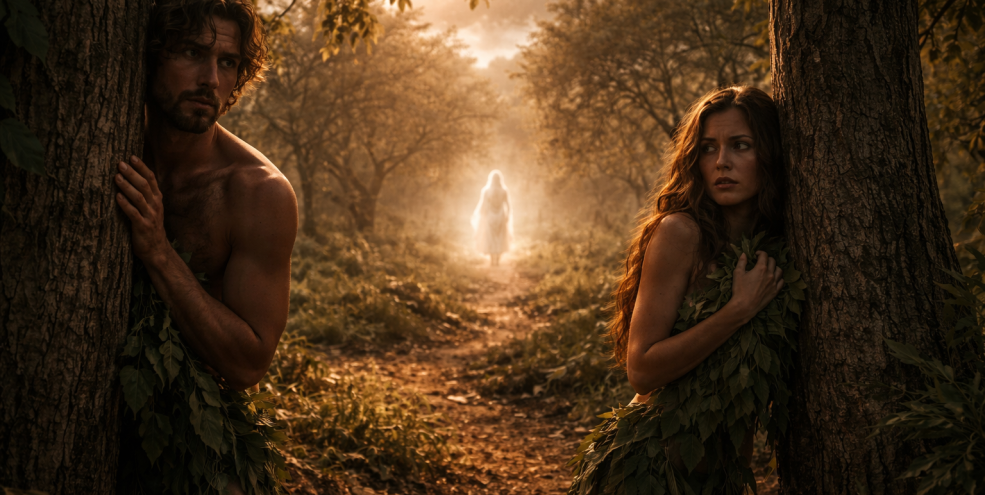
Hiding from God
Later, they hear the voice of the Lord God walking in the garden.
Before this moment, this would have been a time of peace and connection.
But now, something is different.
Adam and Eve hide.
They move away from God instead of toward Him.
When God calls out, “Where art thou?” (Genesis chapter 3 verse 9), it is not because He does not know. It is an invitation.
Adam responds, saying he was afraid because he was naked.
Fear has now entered the world.
The Blame Begins
God asks Adam if he has eaten from the tree.
Instead of taking responsibility, Adam shifts the blame:
“The woman whom thou gavest to be with me, she gave me of the tree, and I did eat.” (Genesis chapter 3 verse 12)
Adam not only blames Eve—he indirectly blames God.
Then God turns to Eve.
She blames the serpent.
This is another result of sin. Responsibility is avoided. Blame replaces honesty.
The Consequences
God then speaks to each one involved.
To the serpent, He declares judgment and foretells that one day the seed of the woman will bruise the serpent’s head. This is the first hint of redemption.
To Eve, He says that childbirth will bring pain, and relationships will become more difficult.
To Adam, He declares that the ground is cursed. Work will become hard. Life will require struggle.
Instead of ease, there will be effort.
Instead of peace, there will be tension.
And then comes the final reality:
“For dust thou art, and unto dust shalt thou return.” (Genesis chapter 3 verse 19)
Death has now entered the world.
God Provides Covering
Even in judgment, something unexpected happens.
God makes coats of skins and clothes Adam and Eve.
This is significant.
Their attempt to cover themselves with fig leaves was not enough. God provides a covering that is lasting.
It comes at a cost.
This moment points forward to a deeper truth—that sin requires a covering that only God can provide.
Driven Out of the Garden
Finally, Adam and Eve are sent out of the Garden of Eden.
They are removed from the tree of life, so they will not live forever in a fallen state.
Cherubim and a flaming sword are placed at the entrance to guard the way.
The place of perfection is now out of reach.
The world outside the garden will be different.
Harder.
Broken.
Uncertain.
What This Means for You
The story of the Fall is not just about Adam and Eve. It explains the world we live in today.
First, it shows how sin begins. It starts with doubt, grows through desire, and ends in action.
Second, it reveals that choices have consequences. One decision can change everything.
Third, it explains why life is not perfect. The pain, struggle, and brokenness we see all trace back to this moment.
Fourth, it shows that hiding does not fix anything. Adam and Eve hid, but God still called them.
And finally, it reveals hope—even here.
In the middle of judgment, God speaks of a future victory over the serpent.
From the very beginning, there is a promise that this is not the end of the story.
The Turning Point of History
Genesis chapter 3 is one of the most important chapters in the Bible.
It explains why things are the way they are.
It shows the seriousness of sin.
But it also shows the beginning of something else—the plan for redemption.
Final Notes
The Fall of Man changed everything.
What was once perfect became broken.
What was once open became separated.
But even in that moment, God did not walk away.
He spoke.
He provided.
He promised.
And from that point forward, the story continues—not just of what was lost, but of what would one day be restored.
Add comment