
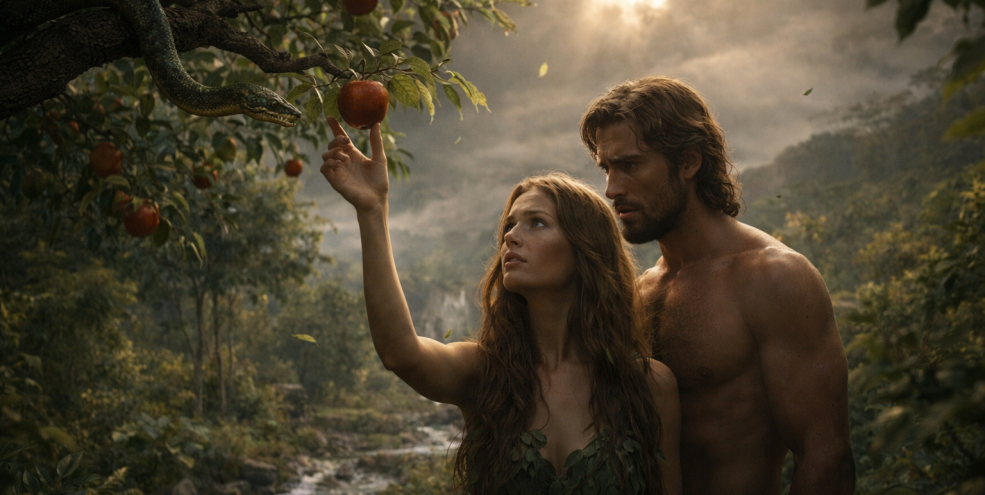
After the world was created—after the light, the sky, the land, the seas, the plants, the animals, and finally mankind—there was a place unlike any other on earth. It was perfect. Peaceful. Full of life. This place was called the Garden of Eden.
The story continues in the Book of Genesis, giving us a closer and more personal look at how life began for the first man and woman.
The Formation of Man
While Genesis chapter 1 gives us the overview of creation, Genesis chapter 2 slows down and focuses on one specific moment—the creation of man.
The Bible tells us that God formed man from the dust of the ground. This is a powerful image. It reminds us that humanity is both physical and fragile, made from the very earth we walk on. Yet something extraordinary happens next.
God breathes into the man’s nostrils the breath of life.
This is not just creation—it is connection. Life itself comes directly from God. The man is not simply made; he is given life by the very breath of his Creator.
And so, Adam becomes a living soul.
The Garden of Eden
God places Adam in a special place—the Garden of Eden.
This was not just any garden. It was full of beauty and abundance. Every tree was pleasant to the sight and good for food. Rivers flowed through the garden, watering the land and bringing life to everything around it.
The environment was perfect. There was no struggle, no lack, no fear. Everything Adam needed was already provided.
In the center of the garden were two important trees:
- The tree of life
- The tree of the knowledge of good and evil
These trees were not just part of the landscape—they represented something deeper. They introduced the idea of choice.
A Command with Meaning
God gives Adam a clear instruction:
He may eat freely from every tree in the garden—except one.
The tree of the knowledge of good and evil.
God warns him that if he eats from it, he will surely die.
This command is important. It shows that even in a perfect world, there is responsibility. Freedom does not mean the absence of boundaries. Instead, it means choosing to trust and obey.
Without choice, there can be no true relationship. God gives Adam the ability to choose, which means love and obedience can be real.
Not Good to Be Alone
As Adam lives in the garden, something unexpected is revealed.
God says, “It is not good that the man should be alone.” (Genesis chapter 2 verse 18)
This is the first time in the creation story that something is described as “not good.”
Everything else had been called good—very good. But now we see that human life is not meant to be lived in isolation.
Adam needs companionship.
Naming the Animals
Before creating a companion for Adam, God brings all the animals before him.
Adam observes them and gives each one a name.
This moment shows that Adam has intelligence, awareness, and authority. He is actively participating in God’s creation.
But something becomes clear as the animals pass by.
None of them are like him.
There is no suitable partner among them.
This highlights a deep truth—human connection is unique. It cannot be replaced by anything else in creation.
The Creation of Woman
God causes Adam to fall into a deep sleep.
While he sleeps, God takes one of his ribs and forms a woman.
When Adam awakens and sees her, he immediately recognizes something profound.
“This is now bone of my bones, and flesh of my flesh.” (Genesis chapter 2 verse 23)
This is the first recorded human words in the Bible, and they express recognition, unity, and joy.
The woman—Eve—is not separate or unrelated. She is part of Adam, created to be his companion.
A Picture of Unity
The Bible then explains something foundational:
“Therefore shall a man leave his father and his mother, and shall cleave unto his wife: and they shall be one flesh.” (Genesis chapter 2 verse 24)
This establishes the foundation of marriage.
It is not just a relationship—it is a union. Two lives becoming one.
This unity is emotional, physical, and spiritual.
From the very beginning, God designed relationships to be close, meaningful, and lasting.
Life Without Shame
The chapter ends with a simple but powerful statement:
“And they were both naked, the man and his wife, and were not ashamed.” (Genesis chapter 2 verse 25)
This tells us something important about the world at that time.
There was no fear.
No guilt.
No shame.
Adam and Eve were fully known and fully accepted.
Their relationship with each other was open and honest. Their relationship with God was pure and unbroken.
This is what life was meant to be.
A World of Peace and Purpose
In the Garden of Eden, everything was in harmony.
Adam had meaningful work—he was placed in the garden to tend it and keep it. Work was not a burden; it was part of purpose.
Eve was his companion, sharing in that purpose.
The animals lived peacefully.
The environment provided everything they needed.
And most importantly, God was present.
There was direct relationship between Creator and creation.
What This Means for You
This story is more than history—it reveals truths that still matter today.
First, you were created with intention. Just like Adam and Eve, your life is not an accident. You were formed with purpose.
Second, you were made for relationship. From the beginning, it was clear that being alone was not good. People are designed to connect—with others and with God.
Third, your life has responsibility. Adam was given work and a command. In the same way, life today includes purpose, choices, and direction.
Fourth, God desires a relationship with you. In Eden, God was close to Adam and Eve. That closeness was not meant to be temporary—it was part of His design.
The Calm Before the Change
Genesis chapter 2 ends in peace.
Everything is good. Everything is whole.
But this moment is also a turning point.
Because the next chapter introduces something new—temptation, choice, and consequence.
The harmony of Eden will soon be tested.
Final Notes
The story of Adam and Eve in the Garden of Eden gives us a glimpse of the world as it was meant to be—full of life, connection, purpose, and peace.
It shows us a God who creates with care, who provides generously, and who desires relationship.
It also reminds us of something deeper.
Before there was brokenness, there was perfection.
Before there was separation, there was closeness.
Before there was struggle, there was peace.
And that original design still points us back to what life was always meant to be.
Add comment