
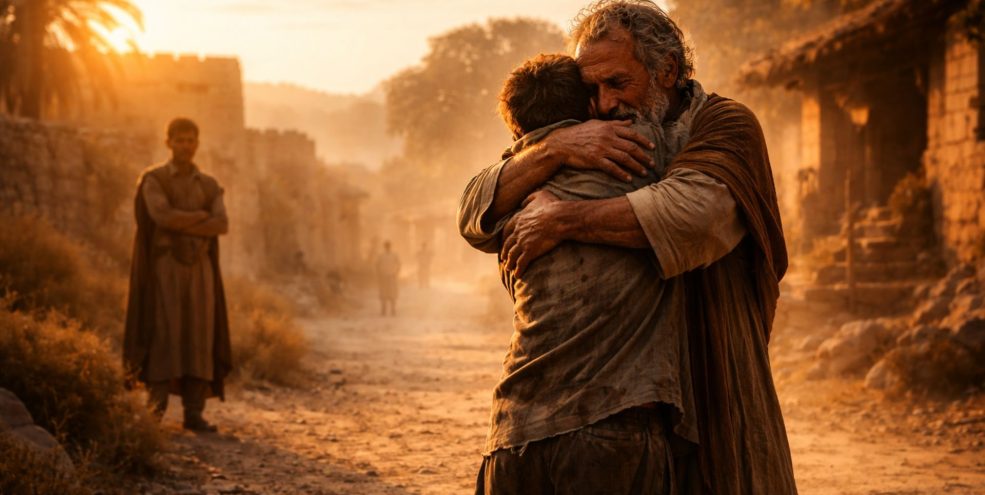
Introduction: A Story You Thought You Knew
Most people know the story of the Prodigal Son. It’s often taught as a powerful example of forgiveness—a rebellious son returns home, and his father welcomes him with open arms.
That’s true—but it’s not the full story.
In fact, the way we’ve labeled this parable has shaped how we understand it. By calling it “The Prodigal Son,” we focus only on one character and miss the deeper message entirely.
The Context Changes Everything
This parable didn’t come out of nowhere.
Jesus told it in response to criticism. Religious leaders were upset because He was eating with sinners and outcasts. In that culture, sharing a meal meant acceptance.
So when Jesus sat with the “unclean,” it created tension.
This story is His response.
It’s not just about a family—it’s about a confrontation between grace and judgment.
The Younger Son: Lost in Rebellion
The younger son’s request was shocking. He asked for his inheritance while his father was still alive—essentially saying, “I wish you were dead.”
In that culture, this was a deep insult.
Yet the father agrees.
The son leaves, wastes everything, and ends up in complete ruin—feeding pigs, which represented the lowest possible state for a Jewish audience.
He has lost everything—his money, his dignity, and his identity.
And then he decides to return.
The Father: A Radical Response
When the son comes back, something unexpected happens.
The father runs.
In ancient culture, a man of status did not run—it was seen as undignified. But the father runs anyway, choosing compassion over reputation.
He restores his son fully.
Not as a servant—but as a son.
This moment reveals the heart of God—one that moves toward people, not away from them.
The Older Son: Lost in Religion
Here’s where the story shifts—and where most people miss the point.
The older son, who stayed home and followed the rules, becomes angry.
He refuses to join the celebration.
He complains. He distances himself. He even refers to his brother as “this son of yours.”
But the father corrects him:
“This brother of yours…”
The older son had everything—but his heart was far from the father.
The Real Message: Two Lost Sons
This is not just a story about one lost son.
It’s about two.
One was lost in rebellion. The other was lost in religion.
The younger son ran away physically.
The older son stayed—but emotionally and spiritually, he was just as distant.
That’s the twist.
The Story Doesn’t End
One of the most powerful parts of this parable is how it ends.
It doesn’t.
We never find out if the older brother joins the celebration.
Why?
Because the story is not just meant to be heard—it’s meant to be answered.
Jesus leaves the ending open so the listener must decide:
Will you come in?
What This Means for You
This story challenges more than behavior—it challenges perspective.
It asks:
Do you celebrate grace—or resist it?
Do you welcome others—or judge them?
Are you close to God in heart—or just in appearance?
It’s not about being “good” or “bad.”
It’s about being aligned with the heart of the Father.
Final Notes
The Prodigal Son is not just a story of forgiveness—it is a mirror.
It reveals whether we are running toward grace… or standing outside of it.

Add comment