
Introduction: A Story That Seems Out of Place
At first glance, the story of Jesus cursing the fig tree feels confusing—even unsettling. Why would Jesus curse a tree simply because it had no fruit? It can appear harsh, almost irrational. But when you step back and look deeper, this moment reveals one of the most powerful symbolic actions in the Gospels.
This was not about hunger. It was about a message.
The fig tree was a living illustration—a warning, a prophecy, and a turning point in spiritual history.
A City Ready for Change
As Jesus entered Jerusalem, the atmosphere was intense. Crowds were shouting “Hosanna,” expecting a political savior. But they misunderstood His mission. Jesus was not there to overthrow Rome—He came to confront something far deeper.
The religious system itself.
The Temple, meant to be a place of worship, had become something else entirely. It was no longer serving its purpose. Instead of drawing people closer to God, it created barriers.
Jesus saw this clearly—and acted.
The Temple Was Broken
Before the fig tree incident, Jesus entered the Temple and drove out money changers and merchants. This was not a random act of anger. It was a direct challenge to corruption.
The system had become controlled and self-serving. Instead of welcoming all people, it limited access. Instead of guiding people to God, it profited from them.
Jesus quoted the prophets to expose the truth: what was meant to be a “house of prayer” had become a “den of robbers.”
This moment set the stage for what came next.
The Fig Tree: A Living Symbol
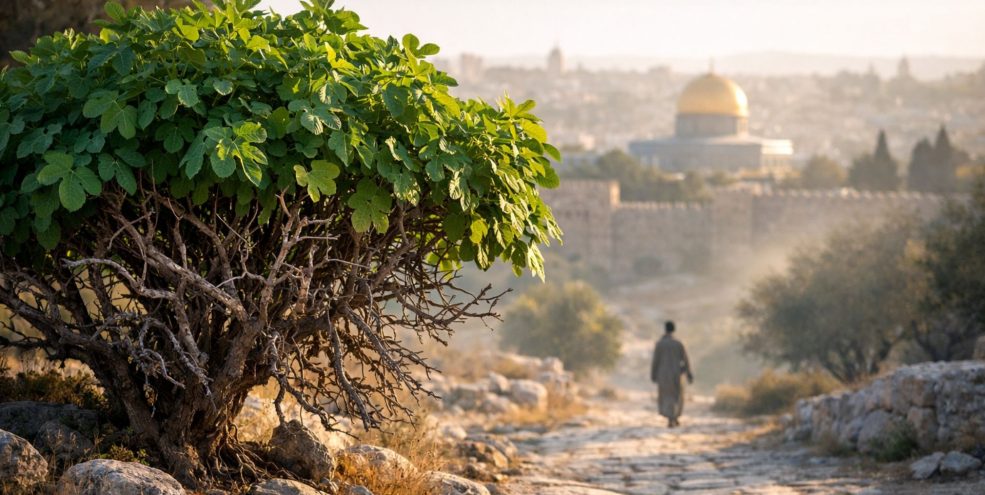
The next morning, Jesus approached a fig tree full of leaves—but without fruit. That detail matters.
In biblical imagery, leaves represent appearance. Fruit represents reality.
The tree looked alive. It looked healthy. But it produced nothing.
This was not just a tree—it was a mirror.
It reflected the condition of the religious leaders and the Temple system. Outwardly impressive. Inwardly empty.
When Jesus cursed the tree and it withered, He was demonstrating a deeper truth: appearance without substance cannot stand.
A Prophecy in Action
This moment connects directly to Old Testament prophecy. In the book of Jeremiah, God speaks of a time when there would be no figs on the tree—a symbol of spiritual failure.
Jesus was not reacting emotionally. He was fulfilling prophecy through action.
He took something physical and revealed something spiritual.
The withered tree became a visible sign that judgment was coming—not on a plant, but on a system that had lost its purpose.
“This Mountain” and What It Really Means
After the tree withered, the disciples were amazed. Jesus responded with a teaching about faith, saying that if they spoke to “this mountain,” it could be cast into the sea.
Many interpret this as a general lesson about overcoming personal challenges. But in context, Jesus was likely pointing to something specific—the Temple Mount.
He was connecting three powerful ideas:
The Temple had been challenged
The fig tree had been judged
The mountain would be removed
This was not just about faith in general. It was about a coming shift.
The old system was ending.
From Structure to Relationship
If the Temple was no longer the center, what would replace it?
That’s where the message becomes personal.
Jesus was preparing His followers for a new way of relating to God. No longer through a system. No longer through a location.
But directly.
The disciples were being called into a new role—to become the living connection between God and the world. A “house of prayer” not made of stone, but of people.
This was a complete transformation.
The Real Question
The story of the fig tree ultimately asks a simple but powerful question:
Are you producing fruit, or just showing leaves?
It’s easy to look the part. To appear strong in faith. To maintain the structure.
But real faith produces something deeper. It changes lives. It reflects truth. It connects people to God.
The fig tree looked alive—but it wasn’t.
That’s the warning.
Final Notes
The cursed fig tree is not a story about anger—it’s a story about truth. It reminds us that God looks beyond appearance and into reality.
Faith is not about how things look. It’s about what they produce.

Add comment